Register Now for Future Placement Programme Register Now

The Diploma in Civil Engineering program is a comprehensive 3 year technical journey designed to develop skilled professionals who contribute to planning, construction, and maintenance of infrastructure that shapes modern society. The program builds strong foundations in civil engineering principles while emphasizing practical site based learning and sustainable construction practices.
Candidates must have successfully completed the Secondary School Examination or equivalent with Mathematics and Science as compulsory subjects from a recognized board.
| Fees Structure | Amount |
|---|---|
| 1st Year Annual | 35000/- INR |
| 2nd Year Annual | 35000/- INR |
| 3rd Year Annual | 35000/- INR |
Admission to the Diploma in Civil Engineering program at Future University is conducted through a transparent, merit based and professionally regulated selection system. The University aims to nurture future civil engineers with strong technical foundations and practical competence.
Admissions are offered through one or more of the following routes:
Admission may be granted on the basis of performance in the Class 10 examination with Mathematics and Science from a recognized board.
A merit list is prepared as per University eligibility norms and academic criteria.
This mode is applicable for selected seats as notified by the University.
Candidates may also secure admission through recognized state or national level entrance examinations.
Admission can be considered on the basis of rank secured in JEECUP Polytechnic or any other approved entrance examination as notified by the University.
Future University conducts its own entrance examination known as FUCET Future University Common Entrance Test.
Applicants are shortlisted based on their performance in the test.
Final selection may include centralized counseling followed by document verification to confirm eligibility and seat allotment.

Future University stands apart through its practice oriented civil engineering education, strong focus on field exposure, and commitment to employability. With modern laboratories, site based learning, and structured placement support, the university prepares students to become competent civil engineering professionals.
• Industry aligned civil engineering curriculum
• Strong emphasis on field work and practical training
• Modern civil engineering labs and surveying facilities
• Skill development focused teaching approach
• Startup and incubation support
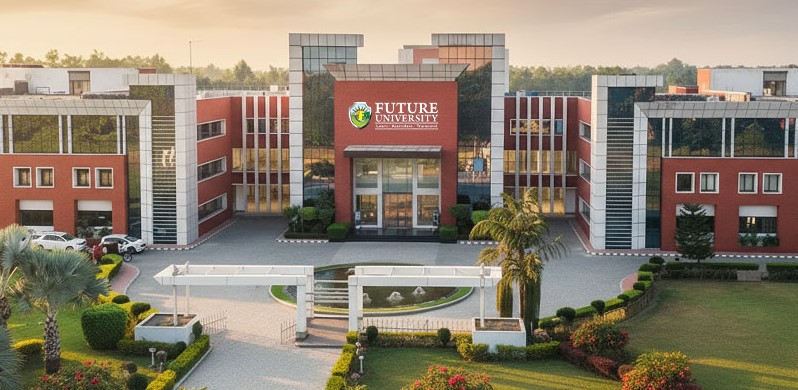
To nurture skilled civil engineering professionals who are innovative, ethically responsible, and capable of supporting sustainable infrastructure development through technical excellence and practical expertise. The department strives to foster construction competence, problem solving ability, and lifelong learning to meet evolving societal needs.
High-demand roles across global tech industries
₹4 to 5 LPA
Supervise construction activities, ensure quality standards, and coordinate on site operations.
₹4 to 5 LPA
Assist in planning, surveying, drafting, and execution of civil engineering projects.
₹4.5 to 5.5 LPA
Support estimation, costing, and material planning for construction projects.
₹4.5 to 5 LPA
Monitor construction quality, test materials, and ensure compliance with engineering standards.




















• Build strong foundations in civil engineering principles and construction practices
• Prepare students for technical roles in construction, infrastructure, and site supervision
• Deliver an industry aligned curriculum integrating theory with extensive field exposure
• Develop safety awareness, technical skills, and problem solving ability
• Provide hands on experience with modern construction tools and technologies
• Industry aligned diploma curriculum
• World class civil engineering laboratory infrastructure
• Practical and field oriented learning approach
• Expert faculty with academic and industry experience
• State of the art civil labs and surveying equipment
• Faculty focused on hands on mentoring and training
• Internship opportunities and site exposure
• Strong placement support and career guidance
• Engineering Mechanics and Building Materials
• Surveying and Levelling Techniques
• Building Construction and Construction Management
• Structural Engineering Basics
• Transportation and Highway Engineering
• Water Supply and Sanitation Engineering
• Concrete Technology and Material Testing
• Computer Aided Civil Drafting
• Sustainable and Green Construction Practices

Where Intelligence Meets Innovation