


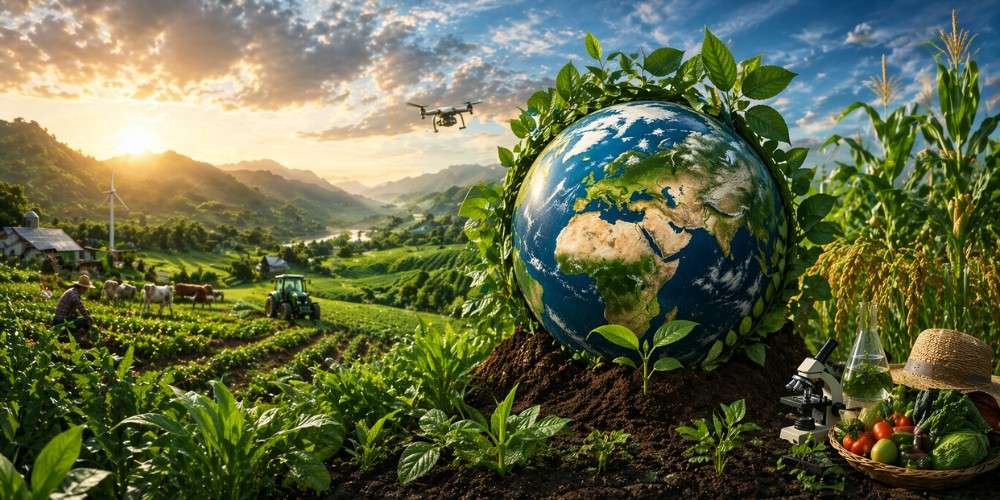
Every year on World Earth Day, we are reminded that protecting our planet is no longer a choice, it is a responsibility. Environmental concerns such as climate change, soil degradation, and water scarcity are reshaping the way we think about development and growth. In this evolving scenario, agriculture stands at the center of the solution. It is not just about food production anymore, but about sustaining ecosystems, preserving natural resources, and building a future that balances productivity with environmental care. This is where BSc Agriculture emerges as a powerful and future ready academic pathway.
The growing demand for environmentally conscious farming practices has made programs like BSc Agriculture more relevant than ever. Students today are not only expected to understand crop production but also to adopt sustainable and smart farming methods that reduce environmental impact. For those exploring options like B.sc agriculture in bareilly up, the focus is increasingly on institutions that combine academic depth with practical exposure and innovation driven learning.
Practical Learning with Modern Agricultural Infrastructure
Modern agricultural education is deeply rooted in experiential learning. Having access to dedicated agricultural land for experimentation allows students to engage directly with the realities of farming. It gives them the opportunity to test techniques, observe crop patterns, and understand soil behavior in real conditions rather than simulated environments. This hands on approach builds confidence and ensures that students graduate with both knowledge and practical competence. It is one of the key reasons why agriculture colleges in bareilly are gaining attention among students who seek real world exposure alongside classroom education.
Equally important is the role of advanced agricultural and agronomy labs in shaping skilled professionals. These labs provide a scientific foundation where students can analyze soil health, study plant growth, and experiment with innovative farming methods. Such facilities encourage a research oriented mindset, supported by strong academic ecosystems with hundreds of research publications that reflect innovation and practical problem solving.
Technology and Multidisciplinary Approach in Agriculture
The future of agriculture is no longer confined to traditional practices. It is becoming multidisciplinary, blending science, technology, and management. This is why multidisciplinary learning has become a defining feature of top agriculture colleges in uttar pradesh. Students are exposed to a wide spectrum of subjects ranging from agronomy and crop production to agricultural economics, rural development, and precision agriculture, helping them understand agriculture as a complete system.
Technology is further accelerating this transformation. The integration of artificial intelligence is enabling smarter farming decisions through predictive analysis and resource optimization. At the same time, drone technology is revolutionizing crop monitoring, land mapping, and precision spraying. Learning these advanced tools ensures that students are prepared for the future of smart and sustainable farming.
Career Growth and Future Opportunities
Another defining aspect of quality agricultural education is its alignment with industry needs. A curriculum that reflects real time agricultural trends ensures that students are not just academically prepared but also professionally relevant. Strong emphasis on sustainable and smart farming practices reinforces environmental responsibility, while field visits and experimental farms bridge the gap between theory and practice.
Beyond academics, agriculture is opening doors to entrepreneurship and innovation. With startup and incubation support, students can explore opportunities in agritech, organic farming, and rural enterprise development. This shift is one of the reasons why institutions recognized as a top agriculture university in uttar pradesh are building ecosystems that support both careers and business ventures.
Career opportunities after BSc Agriculture are diverse and promising. Graduates can work as agronomists with salary ranges of around ₹5 to 8 LPA, focusing on crop productivity and soil management, or as agri business managers earning around ₹6 to 10 LPA, managing agricultural enterprises and market strategies. These roles highlight the strong professional scope of the field.
Conclusion
On this World Earth Day, the importance of agricultural education becomes even more significant. BSc Agriculture is not just a degree, it is a pathway to creating a sustainable and responsible future. It empowers students to contribute to environmental conservation, food security, and rural development in meaningful ways.
For students considering B.sc agriculture in bareilly up or exploring agriculture colleges in bareilly, choosing the right institution can shape both their career and their contribution to society. With the right mix of practical exposure, advanced learning, and innovation, students can become part of a new generation that not only feeds the world but also protects it.